K-Pass vs. Climate Card: Which Seoul Transport Pass Saves You More in 2026?
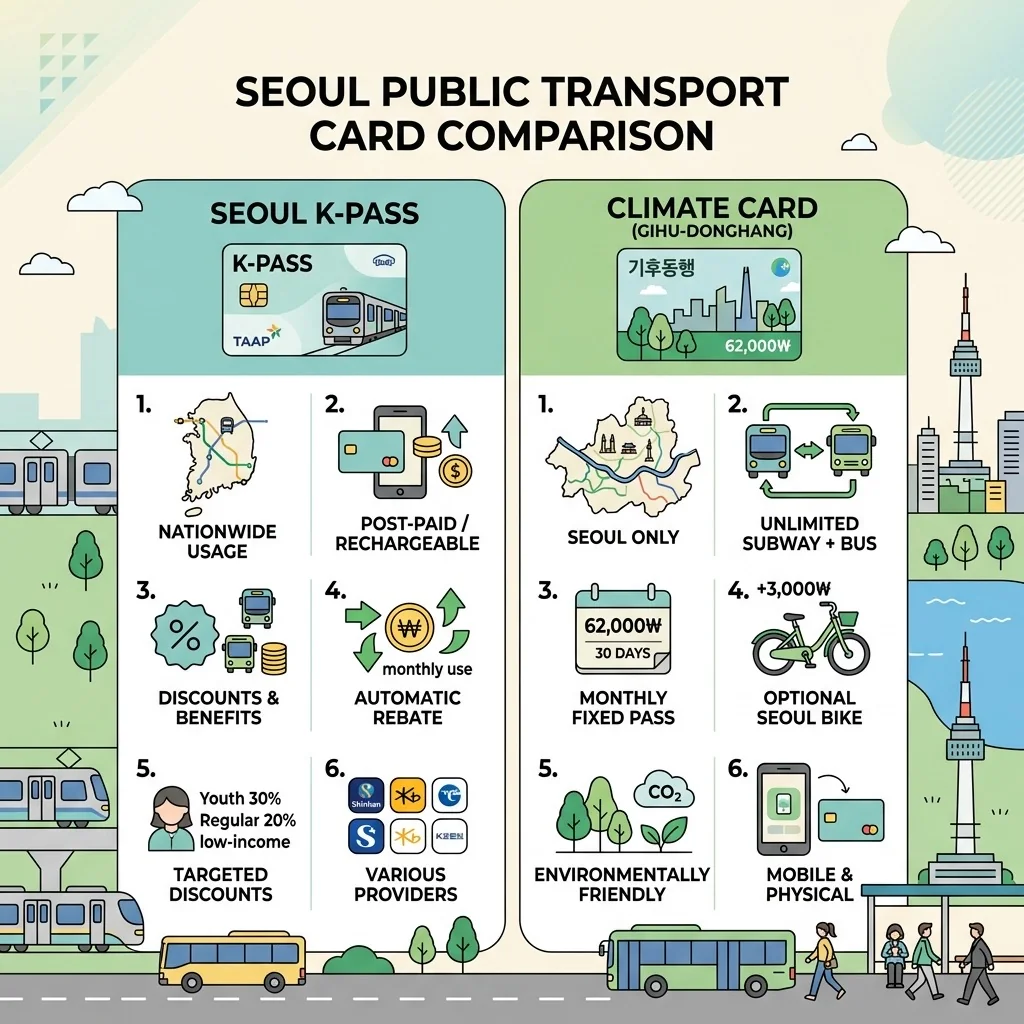
Getting around Seoul used to be as simple as tapping a T-money card and hoping you had enough balance. But in 2026, the landscape has completely shifted. With the nationwide integration of K-Pass and the massive expansion of Seoul's Climate Card (Gihu-donghang Card), choosing the wrong pass is essentially leaving money on the table. I've spent the last month tracking the latest updates from the Seoul Metropolitan Government and the Ministry of Land, Infrastructure and Transport (MOLIT) to break down exactly which card fits your lifestyle.
📌 This article provides general information based on official published data as of April 2026. Transportation policies and rates are subject to change by the Seoul Metropolitan Government and regional authorities.
The 2026 Climate Card: Unlimited Seoul for Everyone
What is the Seoul Climate Card?
The Climate Card (기후동행카드) is Seoul's first unlimited public transportation pass, offering flat-rate rides on all Seoul subways, city buses, and the Ttareungyi bike-sharing system.
For a long time, the biggest hurdle for expats and tourists was the "cash-only" requirement for physical card top-ups. I've walked through the subway stations recently and can confirm that as of 2026, foreign credit cards (Visa/Mastercard) are now fully accepted at self-service kiosks in all major Seoul stations. This is a massive win for short-term travelers who previously had to carry bulky cash to reload their cards.
The 2026 version of the card has also solved the "Incheon Airport Dilemma." While you still cannot start a trip from Incheon Airport using the Climate Card, you can now tap out at Incheon Airport T1 or T2 via the Airport Railroad (All-stop train) without incurring extra fees, provided your journey started within Seoul. This small update has made the card significantly more tourist-friendly.
K-Pass: The Nationwide Cashback Powerhouse
How does the K-Pass work in 2026?
K-Pass is a resident-only refund system that provides 20% to 53% cashback on all transportation expenses nationwide, provided you use public transit at least 15 times per month.
Unlike the Climate Card, K-Pass is not "unlimited." You pay as you go, and at the end of the month, the government deposits a percentage of your spending directly back into your linked Korean bank account. The "magic number" in 2026 is ₩62,000. If your monthly spending is below this, K-Pass usually saves you more. If you spend more than this solely within Seoul, the Climate Card starts to win.
| User Category | 2026 Refund Rate | Estimated Monthly Savings |
|---|---|---|
| General (Age 35+) | 20% Cashback | ₩15,000 - ₩25,000 |
| Youth (Age 19-34) | 30% Cashback | ₩25,000 - ₩40,000 |
| Low-Income Brackets | 53.3% Cashback | ₩45,000+ |
One major technical term to remember is Hwan-geub (환급 - refund). The beauty of the K-Pass is that it covers the GTX (Great Train eXpress), the high-speed commuter rail lines connecting outer Gyeonggi cities to Seoul. The Climate Card currently does not cover GTX, making K-Pass the only viable choice for long-distance super-commuters.
G-Pass and I-Pass: The Gyeonggi & Incheon Advantage
If you live in the surrounding satellite cities, you don't just get K-Pass; you get the Gyeonggi-Pass (The G-Pass) or the Incheon I-Pass. These are enhanced versions of the K-Pass that remove the 60-ride refund cap.
"By expanding the youth age limit to 39 and removing the ride cap, the Gyeonggi-Pass ensures that our residents traveling into Seoul receive the highest level of transportation support in the country." — Gyeonggi Provincial Government, 2026.
Real-World Math: Which Saves You More?
Let's run a scenario for John, a 28-year-old English teacher living in Seoul who commutes 22 days a month (44 rides).
Option A: Climate Card. John pays ₩62,000. He gets unlimited rides. If he goes out on weekends, his "cost per ride" continues to drop.
Option B: K-Pass (Youth). With a standard fare of ₩1,500, John spends ₩66,000. Because he is in the "Youth" category, he gets 30% back (₩19,800). His net cost is ₩46,200.
In this scenario, K-Pass wins by nearly ₩16,000. The Climate Card only becomes cheaper if John's monthly spending exceeds roughly ₩88,000 (about 60 rides) or if he uses the Ttareungyi bikes every single day.
Frequently Asked Questions (2026 Edition)
Can I use the Climate Card on the Shinbundang Line?
Yes, as of 2026, the Climate Card coverage has been expanded to include the Shinbundang Line within Seoul sections. However, if you travel past the Seoul boundary (into Suwon or Yongin), you will be required to pay an additional distance-based fare at the exit gate.
Do I need a Korean bank account for K-Pass?
Yes, a local Korean bank account is mandatory for K-Pass. The cashback is paid out as a direct deposit. If you don't have one yet, you should stick to the Climate Card or a standard T-money card until your banking is set up.
Can tourists get the 30-day Climate Card?
Absolutely. Tourists can buy the physical Climate Card for ₩3,000 at any convenience store and load the 30-day "Unlimited" option. The only restriction is that you cannot use the "Mobile" version of the card without a Korean resident registration number (RRN/ARC).
※ All information is based on 2026 statutory rates and official publications. Individual circumstances may vary. This is not professional financial or legal advice.
The KR INSIDER editorial team consists of long-term residents, certified tax professionals, and immigration specialists based in Seoul. All content is cross-referenced with official Korean government sources including the NTS, MOEL, and NHIS.